
St.George’s Hill has found its flame
I have a confession to make.
Like any well-adjusted person living in 2026, I decompress after work by scrolling mindlessly through social media, scraping the gutters of “content” for one last thimble of serotonin.
Most evenings, it is grim work.
Another new golf course slides into view, looking suspiciously like the last new golf course. The same bleached palette. The same expensive rough edges. The same suggestion that somebody has taken what worked elsewhere and asked for another one of those. Swipe up. Repeat. If you have seen one, you begin to feel as though you may have seen them all.
Just as I was preparing to abandon hope, I landed a content whale.
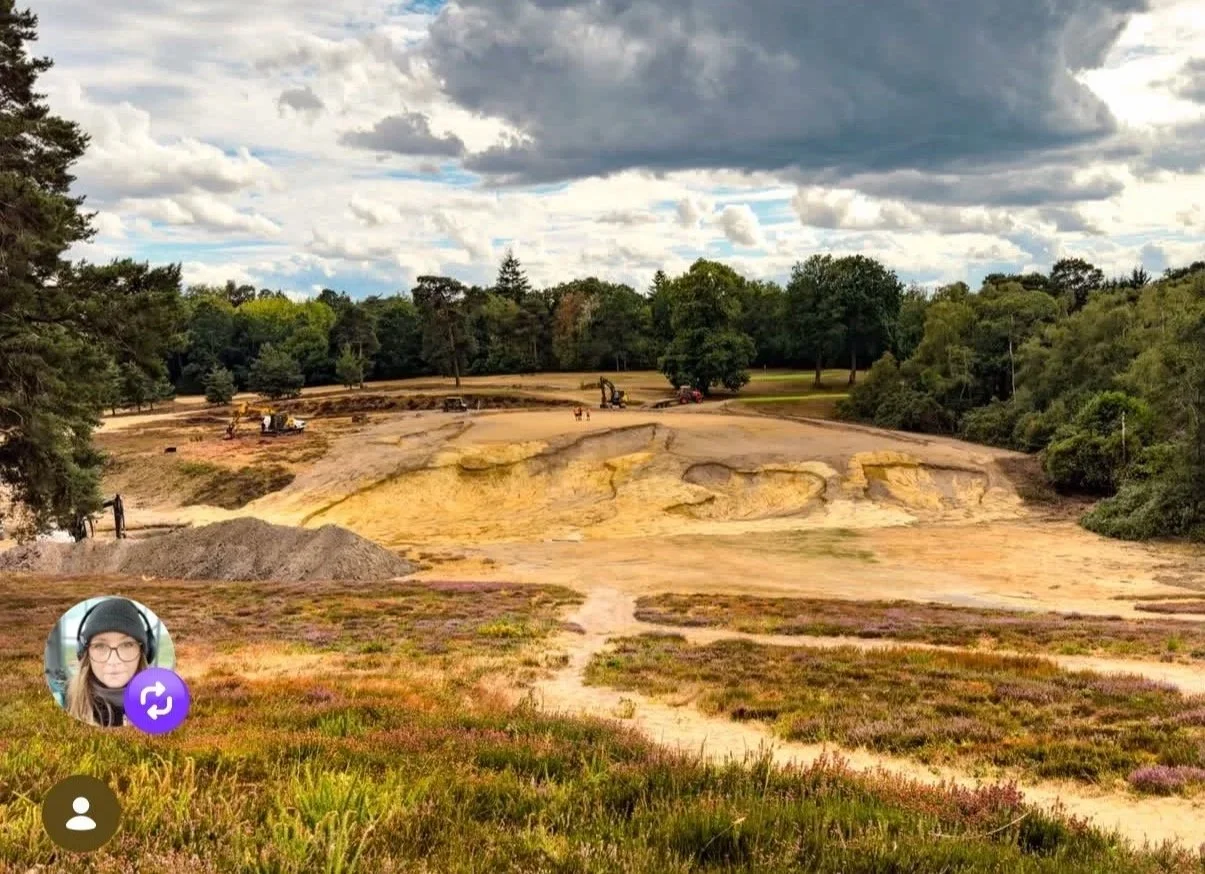
Three collaborative posts appeared in quick succession from Angela Moser, Brian Schneider and Clyde Johnson. The grass had been stripped away from what appeared to be the 8th hole at St George’s Hill, exposing the bare carcass of one of Harry Colt’s great creations.
My brain began to flicker back into service.
The 8th? That is a bold place to begin.
I zoomed in and began examining every pixel for evidence, like a deeply under qualified detective who had nevertheless been given full jurisdiction over Surrey. The bunkers immediately caught my attention. After years of softening and neglect, they appeared to have found their teeth again. The sheer menacing scale of the central bunker back to its intended size.
Then I noticed the people standing on the the well of a green. They offered a useful sense of scale.
And then I saw the flag…
It was planted almost outside the composition of the photograph, far enough away from the recognised putting surface that it seemed improbable. I zoomed in again. Then again, as though the third enlargement might reveal a written declaration of intent.
Surely not.
Could that really be the restored edge of the green?
If it was, they were looking at something in the region of 16,000 square feet. Not a cautious tidy-up. Not the usual restoration language attached to a handful of widened mowing lines and some fashionable bunker edges. This looked like an attempt to recover the scale, strategy and audacity of Colt’s original vision.
All of this, I should stress, was deduced from a flag in the dirt.
I realise how that sounds.
But that flag was not exciting simply because the 8th green might be returning to its proper size. It suggested something larger. It established the possible tone of the restoration and, with it, the potential transformation of the entire golf course.
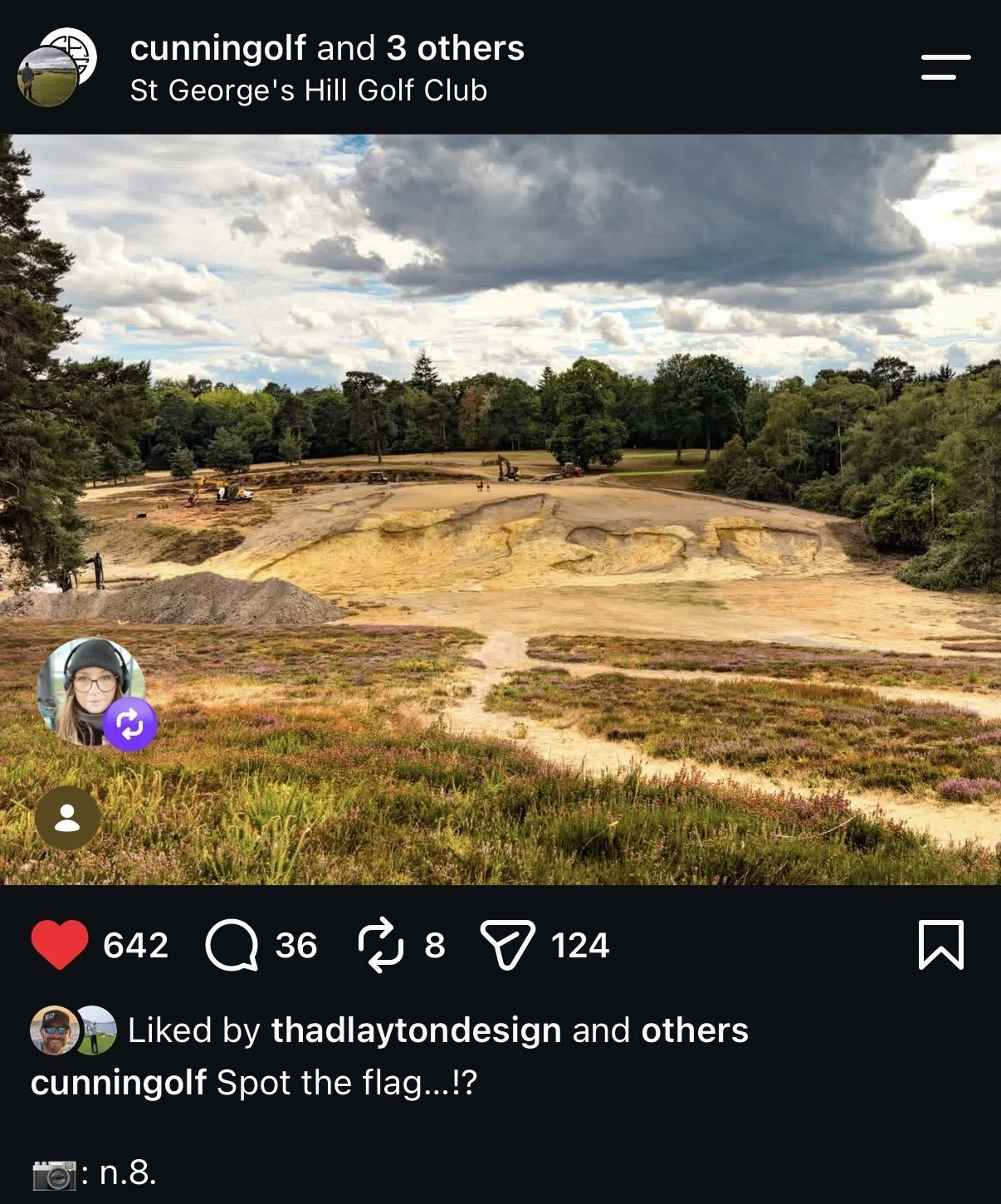
The instagram post…
St George’s Hill does not need to be reinvented. It needs to be remembered.
The ingredients are already there. The heaving terrain, the heather, the pines, the scale and the prestige of Colt’s name. It is one of those rare places where the golf course seems to possess its own internal weather. Yet, like many great courses, time has gradually blurred some of its sharpest ideas. Greens contract. Bunkers lose their edges. Width disappears. What was once bold becomes polite and softly spoken.
Restoration, at its best, is not an exercise in making an old golf course look new. It is the removal of accumulated manners.
That is why the appointment of Moser, Schneider and Johnson (The ABC’s) feels so important. Brian has built a reputation as one of golf architecture’s more committed historical policemen. Angela and Clyde bring their own quiet detective work in the background, practical understanding and instinct for finding what a golf course has been trying to say beneath decades of alteration. They are the best people for the job.
Between them, they appear unusually well equipped to distinguish between historical intent and historical clutter.
Of course, no restoration team operates with complete freedom. Committees deliberate. Members worry. Budgets tighten. Trees acquire unlikely emotional constituencies. Every bold idea must survive a procession of entirely reasonable people asking whether it really needs to be quite so bold.
That may be the only thing standing between St George’s Hill and its full potential.
Because if Moser, Schneider and Johnson are given a clear runway, and if the club has the courage to follow the evidence wherever it leads, there is no reason St George’s Hill cannot become the best golf course in England.
That is not to say England lacks contenders. It is to recognise how much is already present at St George’s Hill, and how little needs to be invented. The opportunity is not to manufacture greatness, but to uncover it.
Perhaps I have read too much into one photograph. Perhaps the flag was planted there temporarily. Perhaps it marked a drainage outlet, a lunch order or the precise location where three golf architects had agreed to bury a rock.
But I do not think so.
I think it was a small flag signalling an enormous amount of ambition.
The next destination golf course can wait. For now, the course I am craving to play is an old one in Surrey, being slowly stripped back to reveal just how good it may have been all along.
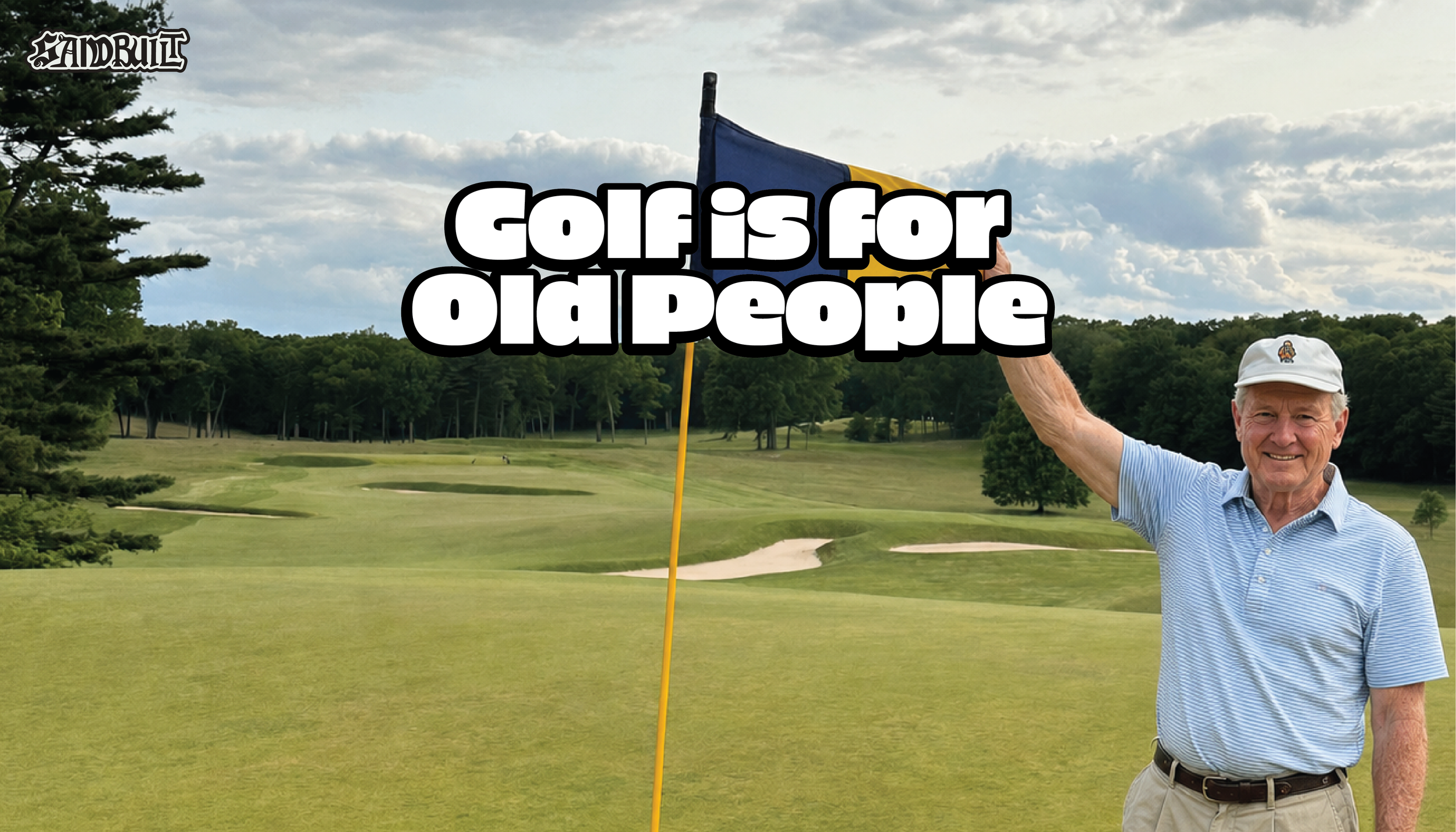
Golf is Still for Old People
Let me take you back to my teenage years.
It's a Saturday night somewhere on the outskirts of Melbourne. Out past where the trains run.
It's an old saying that always made sense to me. The suburbs had stretched further than the infrastructure had. It was a little rough around the edges. More blue-collar than blue blood. More Commodores than country clubs. It was a long way from the manicured image of Melbourne's Sandbelt. It felt much closer to the old Croydon Golf Club where I'd be teeing off the following morning.
Warm cans of beer. Music echoing through the garage that had temporarily transformed itself into a dance floor. These were social evenings where reputations were made and lost. Stay long enough to prove you weren't boring. Don't stay so long that you made a fool of yourself. If you were lucky, you might even convince a girl to tolerate your company for longer than twenty minutes.
All the while, there was one thing sitting quietly in the back of my mind.
An 8:12 tee time at Croydon Golf Club.
The great social challenge wasn't surviving the party.
It was leaving it.
Too early and you were labelled a loser. Too late and Sunday's golf was ruined before you'd even hit the first tee shot. So, somewhere around midnight, I'd begin the slow, awkward extraction. A few vague goodbyes. A disappearing act towards the front door. Usually interrupted by someone asking the inevitable question.
"Where are you going?"
Without fail I'd mumble something that sounded embarrassingly uncool.
"I've got golf tomorrow morning."
The response was almost always identical.
"Golf?"
"...isn't golf for old people?"
At the time, I hated hearing it.
Now I think they might have been right.
Not because golf isn't attracting younger people. Quite the opposite. Many of the same people who laughed at me back then have now discovered golf for themselves. Every second bloke I grew up with seems to be documenting their Road to Scratch, uploading swing videos that absolutely nobody asked for and suddenly developing very strong opinions on low-spin golf balls and bounce angles. Golf appears to be booming amongst people in their thirties.
I just don't think that's as revolutionary as everyone makes it out to be.
Football starts hurting. Cricket consumes an entire weekend. The psychopaths discover marathons and triathlons.
The rest of us discover golf.
Golf hasn't become younger. We've simply become older.
And once that thought lodged itself in my head, it became very difficult to ignore.
For the last few years we've spoken about golf as though it's experiencing some great youth movement. Every article seems to celebrate another influx of Millennials, another waiting list, another impossible Saturday morning tee sheet. The assumption is that golf has suddenly become fashionable.
I'm not convinced.
I think we've mistaken growth for accumulation.
Golf isn't simply attracting new players. It's retaining old ones for longer than ever before.
People don't get old like they used to.
The seventy-year-old golfer of today often resembles the fifty-five-year-old golfer of thirty years ago. They're healthier. They're stronger. They retire with more time, more money and better equipment than previous generations ever enjoyed. Golf should celebrate every bit of that. It is one of the great success stories of modern sport.
But success has consequences.
Whenever conversation turns to crowded golf courses or impossible tee times, younger golfers become the convenient target. It's the Instagram generation. The hoodie brigade. The YouTube golfers filming every shot before telling us they "left it out there today."
I don't think they're the reason.
I think we've quietly overlooked the generation that never left.
The old golfers I remember from Sunday mornings haven't disappeared. They're still somewhere across Melbourne's eastern suburbs. Kicking the dew off fairways before most people are awake. Telling the same stories that somehow improve with every passing year. Arguing over gimmies. Having the same friendly disputes over whose shout it is in the clubhouse. Perhaps a little weary from the night before, but never too weary for golf.
Somewhere along the way I became the age they always seemed to be.
They just kept playing.
You can almost read that story through the architecture of modern golf.
Look around any golf club that has invested heavily over the last twenty years. Additional tee complexes. Longer championship tees. Forward tees. Kilometres of cart paths. Bridges designed for fleets of golf carts. Larger cart sheds. Charging stations. Gentler walking grades. So much of modern golf construction has been devoted to extending playing careers.
None of that is a criticism.
Accessibility matters.
Keeping people playing matters.
I'd argue it's one of golf's greatest achievements.
But golf courses are historical documents. Every bridge, every path and every tee tells you something about the generation that built them. Ours tells the story of a game determined to help people play for as long as possible.
There's another irony hiding in plain sight.
Technology has helped younger golfers hit the ball dramatically further than previous generations, forcing courses to stretch backwards. Meanwhile, many older golfers refuse to move forward because a different coloured tee somehow feels like surrender. So we continue building more infrastructure rather than embracing the infrastructure we've already built.
Golf has become exceptionally good at extending playing careers.
I'm just not sure we've spent the same amount of energy asking what sort of game we're extending.
Because if we continue building a game almost exclusively around today's golfers, what exactly are we handing to tomorrow's?
That, for me, is the more interesting question.
Before every retired member reaches for the keyboard, let me say this.
Some of the greatest golfers I've ever known have also been the oldest.
They were the people who first taught me that golf wasn't simply about making birdies. They taught me why Alister MacKenzie mattered before I knew who he was. They taught me that the walk between shots was often the best part of the round. They taught me that golf wasn't simply recreation. It was history. It was architecture. It was community.
Most importantly, they taught me stewardship without ever calling it stewardship.
I think about legacy a lot. My profession almost demands it. Every golf course we restore, every bunker we reshape and every green we expand is an acknowledgement that someone else will inherit those decisions long after we're gone. You begin to understand that time is the most important design material you work with.
Perhaps that's why I find myself repairing two pitch marks instead of one.
Why I'll fill a divot that isn't mine.
Why I'll happily spend five minutes talking to a nervous junior before their first competition.
Not because those things change the world.
Because they quietly shape the one that comes after you.
Golf has spent decades making itself a wonderful game for older people.
Now it needs older golfers to do what they've always done best.
Show the rest of us how to look after it.
One day the Golden Generation will hand the game to mine.
One day mine will hand it to the next.
I still think about those Saturday nights from time to time. Leaving early never felt particularly cool. At fifteen, I thought I was sacrificing something.
Looking back, I wasn't.
I was inheriting something.
One day I'll probably be one of those old blokes somewhere east of Melbourne, kicking the dew off a fairway before the sun has properly risen. I'll tell stories that become slightly better every year. I'll probably complain about bunker sand. I'll almost certainly think golf balls went further in my day.
When that happens, I hope the teenager standing on the first tee looks at me and quietly says,
"Golf is still for old people."
I hope they're right.
Architectural intuition

A common courtesy, or perhaps a common punishment, of being a professional in 2026 is being asked how Artificial Intelligence might improve your job.
That opening sentence sounds like it belongs beneath a headshot on LinkedIn, probably next to the words disruption, workflow and unlocking potential. But the question keeps appearing, and in golf course architecture, it is genuinely interesting. So, against everyone’s better judgement, including my own, it seems worth exploring.
If we were to imagine a blank canvas, land surveyed, boundaries defined, contours mapped, and the site sitting there waiting to become a golf course, the immediate temptation is to ask AI to design it. Feed the machine the data, press the button, and wait for eighteen holes to appear like some strange architectural microwave meal.
But I don’t think that is where its value lies.
The value, at least today, is not in replacing architectural intuition. It is in informing it.
AI could become a way of gathering, sorting and testing the layers that already influence good design. The architect still needs to decide what matters, what to ignore, what to exaggerate, and what to ruin beautifully with a bulldozer. But AI may help us see the site more clearly before we start pretending we saw it all along.
Prevailing Winds
Most parts of the world have recorded wind data. In theory, AI could help translate that information into something useful during routing.
Not simply “the wind comes from the south-west”, but how often, how strongly, and at what times of year. That could influence hole direction, length, par, and the balance of the round.
The goal would be to avoid designing a course where the golfer spends four hours slugging shots into the wind like they are trapped on some horror golfing treadmill, questioning their hobbies and possibly their marriage.
Hydrology
Water is one of the great, unglamorous foundations of golf architecture.
It determines where turf survives, where foot traffic gathers, where machinery can move, where greens should sit, and where the land quietly says, “please don’t build that here.”
Much of this is still understood by walking the site, watching it, feeling it underfoot, and seeing what happens after rain. But AI could help layer hydrology data over the property in a way that gives the architect a clearer early understanding of the site’s behaviour.
It could help identify natural green sites, sensible tee locations, drainage corridors, wet areas, dry ridges, and the places where intervention might be necessary. Not to remove feel from the process, but to support it.
Demographic
Golfers are not all the same, which is an obvious statement that somehow still needs repeating.
If a club understands who is actually playing the course, how far they hit it, how widely they disperse it, and where they struggle, AI could help shape a more intelligent design response.
This does not mean building a course by spreadsheet. That sounds horrible. But it may help determine how many teeing areas are really needed, where they should go, and whether variety is more valuable than simply stretching the course backwards until everyone is miserable.
A better understanding of golfers could lead to better shared experiences. The same bunker, the same water hazard, the same angle of attack, but encountered differently by different players.
That is where design becomes interesting.
Scale
Scale is one of the great hidden ingredients of golf architecture.
The length of holes, the size of greens, the width of fairways, the scale of bunkers, the climb of the land, the rhythm of par, the feeling of moving through space. All of it matters.
AI could help set broad tolerances. Minimum and maximum hole lengths. Green sizes. Bunker scales. Tee locations. Walking distances. Elevation changes. The distribution of par across the round.
The more generous the tolerance, the more likely we are to find variety. The tighter the tolerance, the more likely the golf course begins to feel like it was extruded from a municipal sausage machine.
They say variety is the spice of life. Personally, I like a golf course with a kick.
Iteration
One of the first principles taught in architecture school is the value of iteration.
Do it again. Try it another way. Turn it upside down. Make the bad version. Find the mistake that becomes the idea.
Golf architecture has always had this. Many clubhouses have a framed routing plan on the wall, usually admired by golf nerds who stare at it with the emotional intensity of people reading a lost religious text.
“What could have been.”
“The missing holes.”
“The alternate seventh.”
AI could make this process faster. Not better by default, but faster. It could produce routing options in seconds, allowing the architect to compare different approaches, red-line them, combine them, reject them, and begin designing from a more informed position.
The danger, of course, is mistaking speed for quality. A quick answer is not necessarily a good one. It is just quicker at being wrong.
But as a tool for iteration, AI could be genuinely powerful.
The Human Part
I am still a novice in how I use AI, and AI is still a novice in golf course architecture, although probably learning at a more alarming rate than I am.
But even today, much of what I have described feels possible. With the right data, the right prompts, and a patient enough operator, AI could already help test winds, hydrology, demographics, scale and routing options.
At the moment, getting there might take a couple of days of careful prompting, failed attempts, strange outputs, and the occasional result that makes you wonder if the machine has ever seen a golf course, or grass.
In a few years, that same process may take seconds.
I am in favour of that.
Not because I want AI to design golf courses, but because I want more time to break the rules of the plans it produces. More time to walk the site. More time to stand on a green pad and decide it should move three metres left. More time to shape the land, test the idea, and find the little moments that no dataset can quite understand.
Golf architecture has always lived somewhere between information and instinct.
AI may improve the information.
The instinct still has to come from somewhere else.

French Chardonnay in the Napa Valley
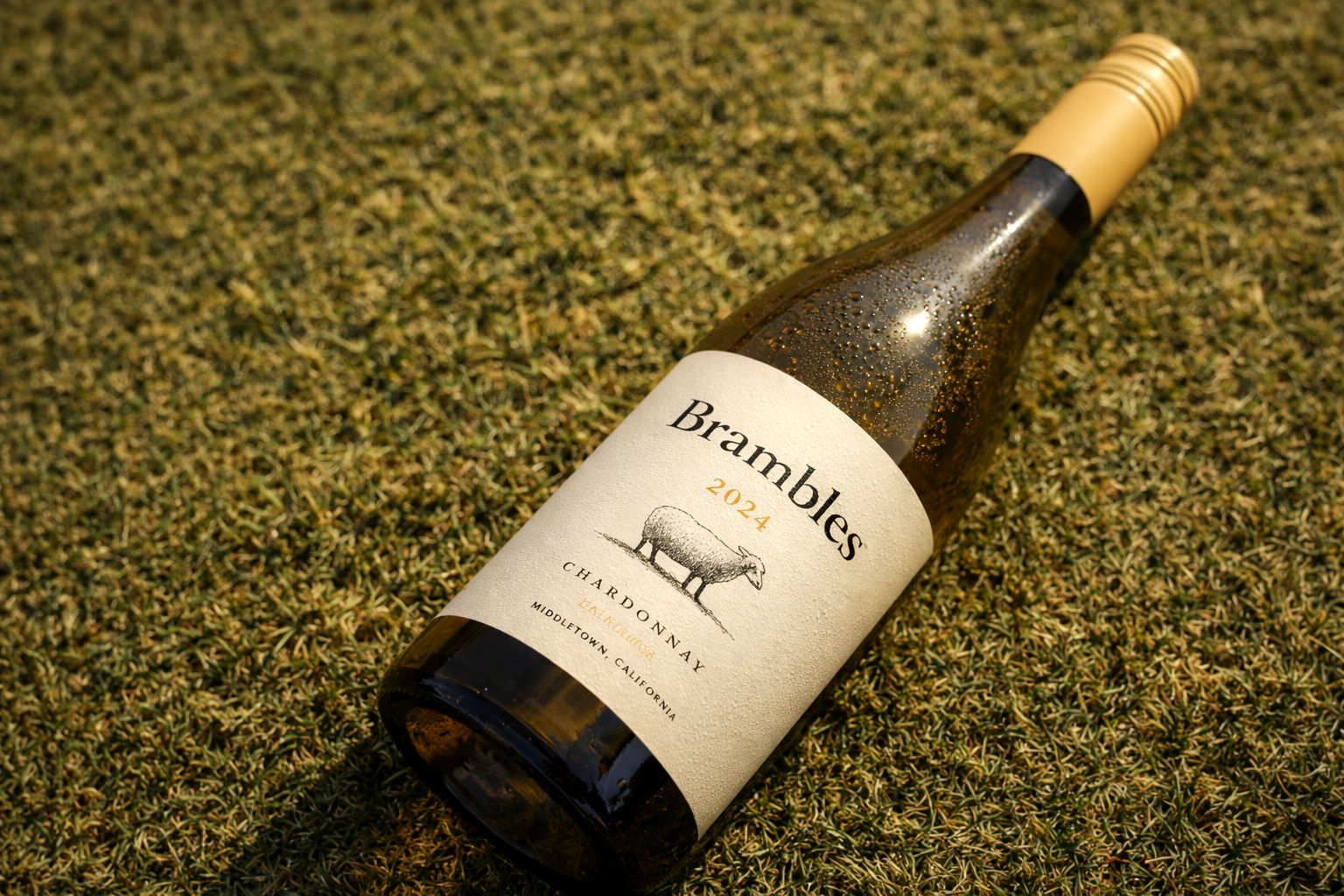
There’s something slightly disarming about arriving at Brambles. Not because of what it is, but because of what it isn’t trying to be. In an era where new golf courses tend to arrive fully dressed for the part, pressed, polished, and pre-approved by an imaginary panel of investors and Instagram architects, Brambles feels… unfinished. And that’s precisely its charm.
Opened in 2024 in Middletown, this is a course that doesn’t present itself as a final statement. It plays more like a question than an answer. There is a visible restraint here, a willingness to leave space for the course to evolve rather than forcing it into a fixed identity too early. It suggests an open-minded curiosity from its creators, not just about what the course is, but what it might become.
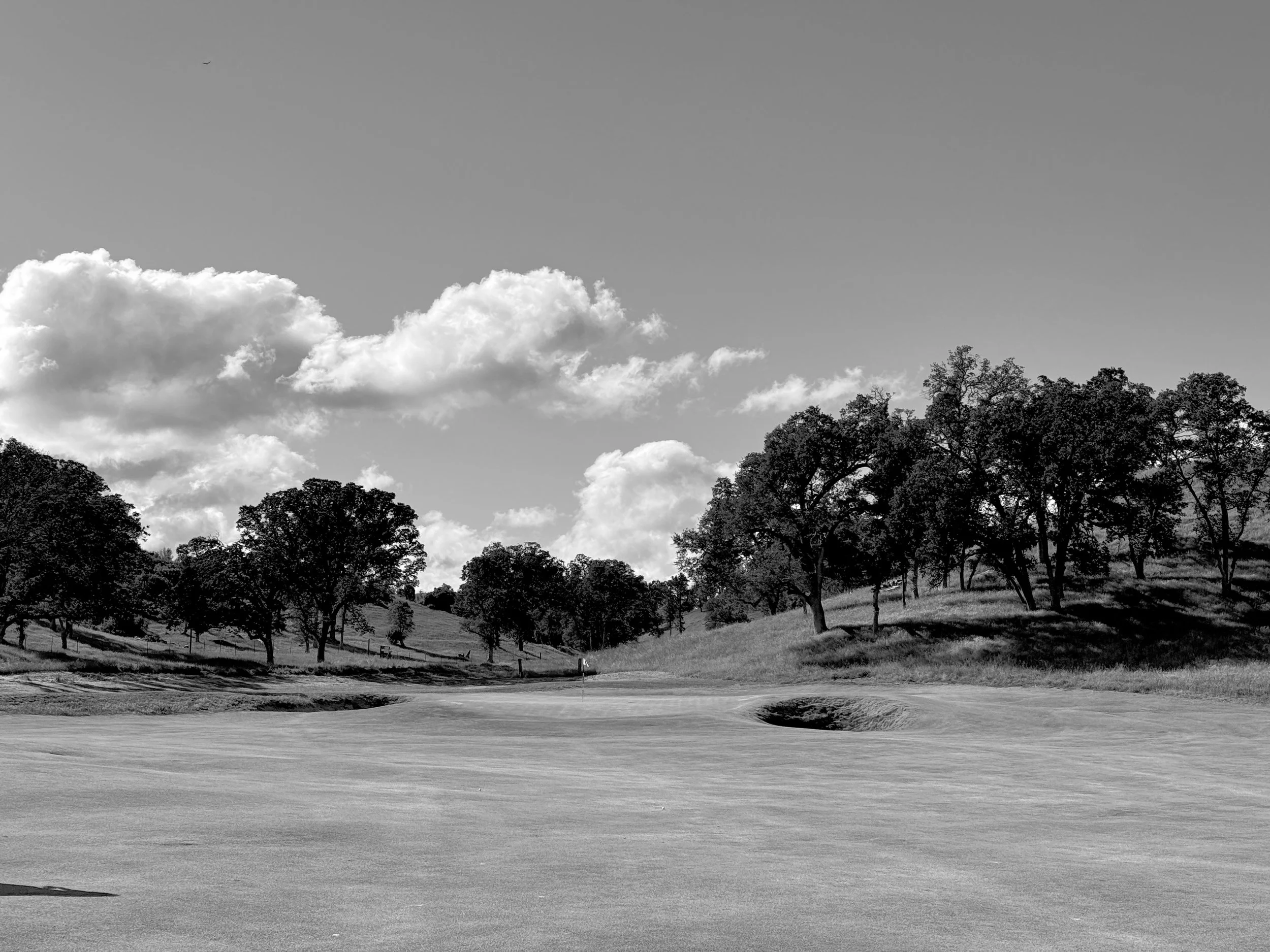
The approach to 16 Green.
Because modern golf development, particularly in the wake of the game’s recent boom, has leaned toward two predictable poles. Commercially safe imitations on one side, echoes of what has already worked, repackaged with just enough variation to feel new. On the other, courses that lean heavily on spectacular settings, where the land does most of the storytelling and the golf simply follows along politely. Brambles resists both. It feels less like a finished product and more like something in flux. Alive, slightly unsettled, and all the better for it.
And perhaps the best way to understand it is through wine.
Chardonnay, in 2026, broadly lives in two worlds. There’s the French expression, restrained, mineral-driven, lightly touched by oak. It doesn’t announce itself. It unfolds. Texture over power. Precision over presence. Then there’s the Napa Valley style, rich, full-bodied, unapologetically buttery. It arrives fully formed, confident, immediate.
Brambles is unmistakably the former, set right in the heart of the latter.
Within reach of Napa Valley, where boldness has long been the prevailing language, Brambles feels almost rebellious in its restraint. A French Chardonnay in Napa country. It goes against the grain, not loudly, but quietly, confidently.
There’s a sensation here that’s difficult to articulate but instantly recognisable. Playing Brambles today feels akin to stepping into the early life of the courses we now revere. Not as museum pieces, but as living, breathing experiments. Before the edges were refined, before reputations calcified, before mythology took hold. For better or worse, it evokes something like Augusta National Golf Club in its infancy. Not in grandeur or ambition, but in spirit. A place still figuring itself out.
And that lack of polish is not a flaw. It’s the point.
There are moments where the ground feels unresolved, where lines are still being discovered rather than dictated. Greens that don’t yet feel like they’ve settled into their final expressions. Edges that blur instead of declare. But within that ambiguity lies the thrill. The golf is engaging, often surprising, occasionally uneven, but always alive. It asks you to participate, not just execute.
This isn’t a blight on the course. It’s what makes it compelling. Inspiring, even. There’s ambition here, but it’s patient. It trusts that time, play, and subtle iteration will reveal what Brambles ultimately wants to be.
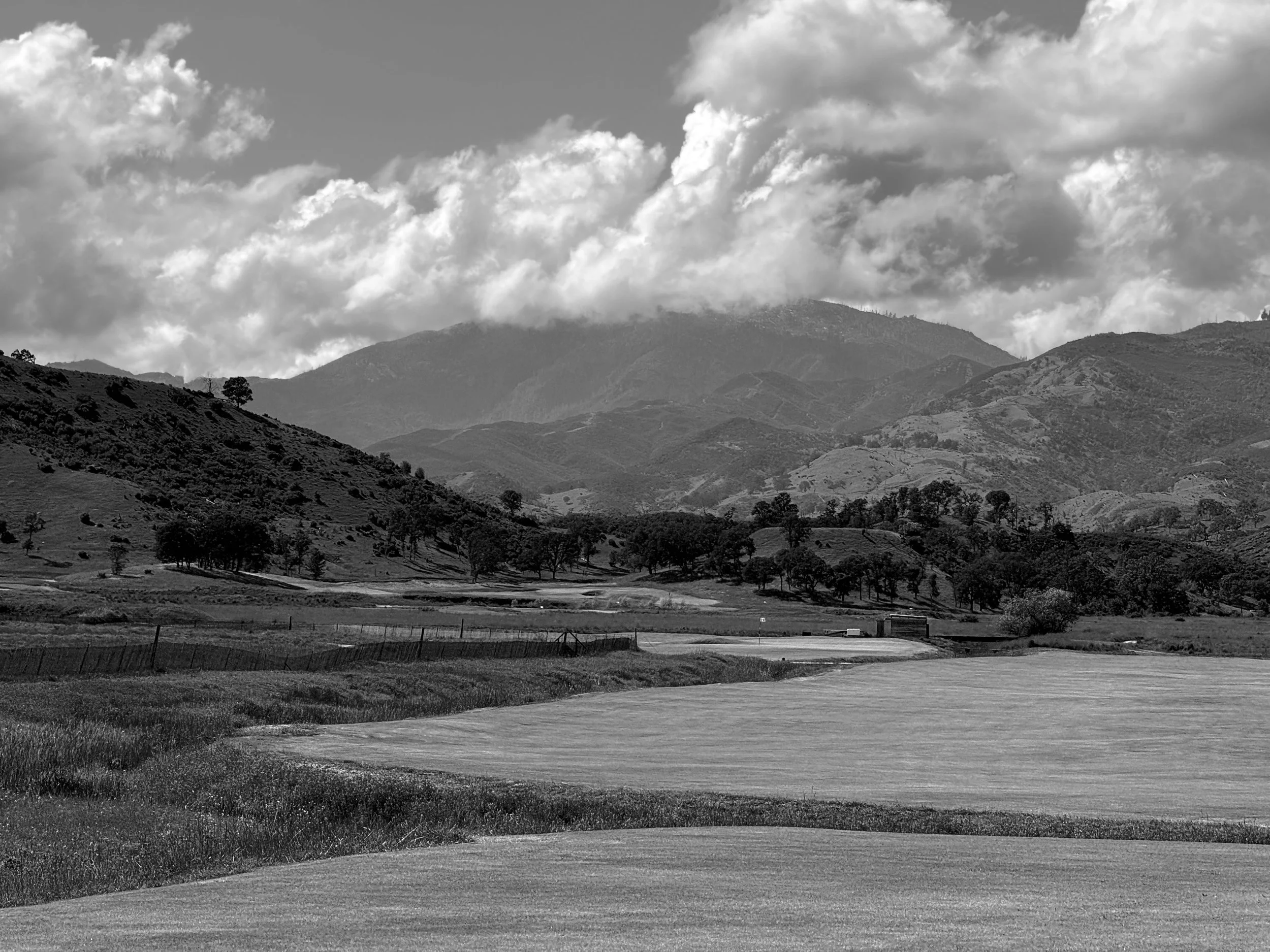
The risk & reward of the 9th fairway.
That philosophy feels deeply aligned with the work of Bill Coore and Ben Crenshaw, whose fingerprints are all over the place, alongside the very real dream of their long-time associate James Duncan. This isn’t architecture chasing applause. It’s architecture willing to wait.
Because Napa didn’t become Napa by accident. Robert Mondavi and his contemporaries helped define a style that was confident, expressive, and immediately recognisable. Big wines, fully realised, built to leave an impression. In many ways, modern golf architecture has followed a similar path. Capable of delivering finished products from day one, polished and complete.
But standing on the ground at Brambles, it’s hard not to feel the appeal of something else. Something a little less resolved. A little more patient. Like those French Chardonnays that don’t give you everything up front, that ask for time, and reward it quietly.
Brambles doesn’t quite tell you what it is just yet.
And that might be the most interesting thing about it.
Happy Golfing,
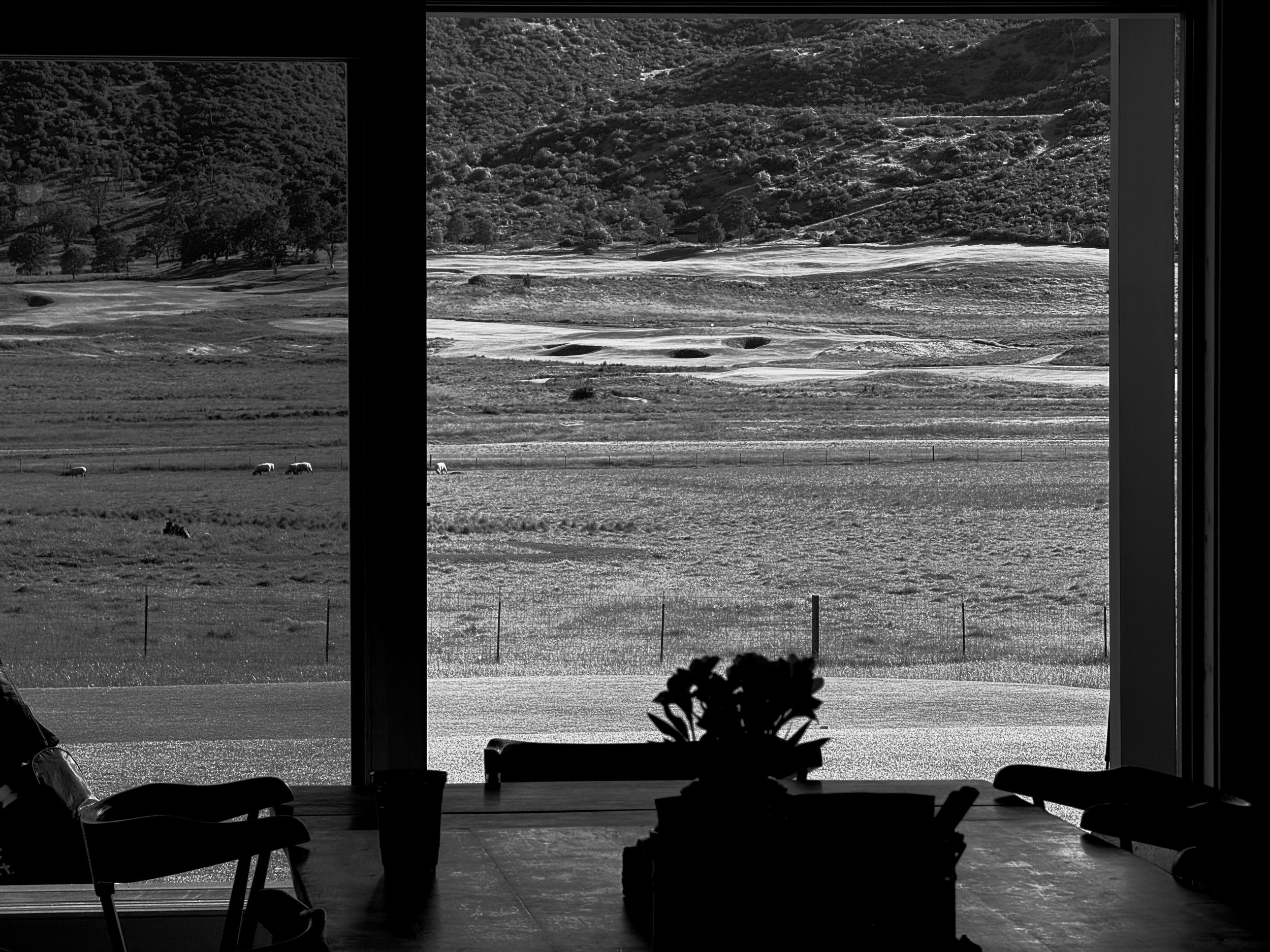
One of my favourite clubhouses.
The Whole Carcas
The smell of diesel cuts through the frozen spring air. A dozer idles somewhere behind me, its engine coughing quietly in the cold, and the ground beneath our boots is only just beginning to soften after a long winter. The machines leave not so faint tracks in the damp soil and I’ve lost feeling of my extremities. They will not be felt until I return back home to Australia.
This is not a grand reconstruction. These projects will not set the internet on fire. There are no dramatic unveilings or launch videos being edited somewhere. Just existing golf courses getting a bit of attention before the season properly begins.
Just a small construction zone on an existing golf course. A bunker in need of restoration. A fairway grade that never quite worked. A green edge that can finally accommodate a dubious pin location. It’s small work. Patchwork work. And when you stand inside a little piece of land like this, your mind naturally shrinks down to the details. Not the whole golf course. Just the ground in front of you.
How much can we get out of this small moment? How resourceful can we be with what is here? It is a surprisingly useful exercise and work I really enjoy doing.
The off season back home leaves a lot of room for observation. The world of golf architecture tends to keep moving while you are not looking. Destination golf continues to surge forward and the old Field of Dreams logic of “build it and they will come” keeps pushing projects further and further toward the edges of the earth. Remote peninsulas. Clifftops and Hidden Valley’s
The landscapes are spectacular and the architecture placed upon them is often very good. Some of the finest minimalist architects working today are shaping those places with real care and restraint. The photographs are breathtaking. And most of these courses will open to immediate discussion about where they belong among the best in the world.
But after staring at enough of those images a small question begins to linger. What exactly are we celebrating? Many of these new places feel like a sequence of individual golf holes interacting with a spectacular landscape. A green sitting against the ocean. A tee perched above a cliff. A fairway weaving through dunes that look as though they have existed forever. Each hole becomes its own moment between golf and scenery. Individually they can be extraordinary. But taken together something about it can feel slightly indulgent. The land is so dramatic that the architecture becomes a series of beautiful placements rather than a complete act of use. The landscape becomes the ingredient rather than the whole animal.
There is nothing inherently wrong with that approach. The results can be breathtaking. But it is not quite the flavour of golf architecture that resonates most strongly with me. The courses that stay with me tend to operate differently. They feel devoted to golf.
Alwoodley in Leeds is a good example. Once you cross the road and step into that broad paddock of land the entire place feels as though it exists purely for the game. The land is not presenting a handful of dramatic stages. It is simply being used.
Kingston Heath works in much the same way. Its beauty lies in small reveals and glimpses of other holes through the trees. Golf that has just happened. Golf that is about to happen. The entire property feels like a continuous conversation with the game.
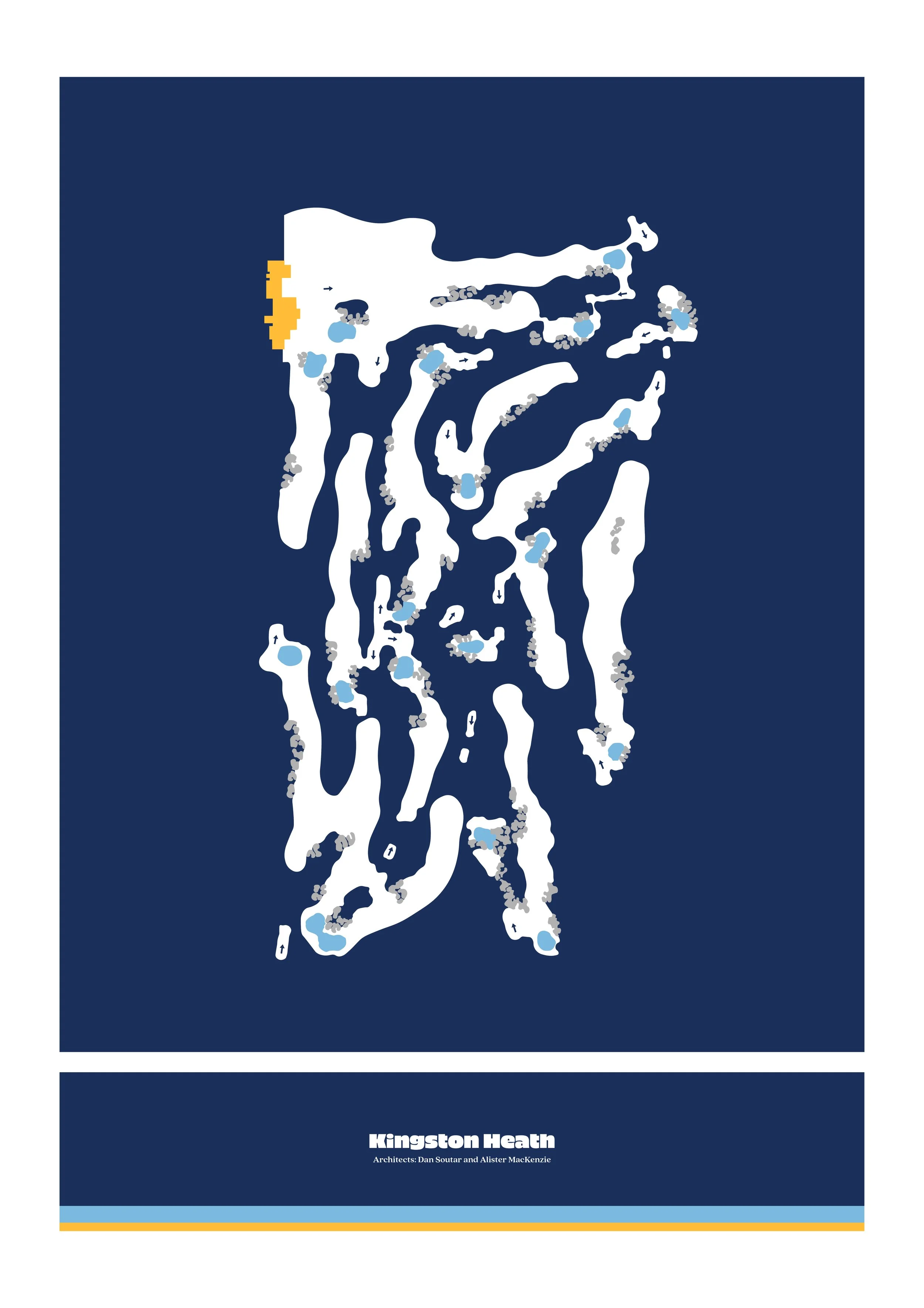
Kingston Heath’s routing uses the whole carcass
And then there is the Old Course at St Andrews. A place where the land has been used so completely that the course feels almost infinite. Fairways overlap. Holes share corridors. Golfers move across the same ground in several directions.
It does not feel indulgent.It feels efficient. The land is not hosting the golf. It has surrendered itself to it. This is where the chicken carcass comes in.
A competent chef can carve a chicken into beautiful pieces. Breast here. Thigh there. Each portion plated neatly on its own. But the best chefs use the entire carcass. The bones become broth. The scraps become something else entirely. One ingredient becomes several meals. Great golf land can work the same way.
Some courses carve beautiful portions out of spectacular landscapes. The ones I admire most feel like they have used the entire animal. Every fold of ground. Every corridor. Every slightly awkward piece of land that had to be solved rather than admired. Nothing wasted.
Standing here in the smell of diesel and damp earth, working inside a small corner of a golf course that just needs a bit of care, that idea keeps returning. How much golf can a piece of land truly hold? How much of it can be used? And perhaps the better question is simply this. Do we prefer courses that borrow spectacular landscapes for golf? Or the ones that surrender the entire landscape to the game?
Happy Golfing
2016
The internet has a knack for turning even the simplest ideas into something divisive virality or mildly dangerous. No matter how edible Tide Pods might look. But the recent trend of sharing your digital footprint from ten years ago is one I can get behind. Mostly because it arrived at exactly the right moment.
Looking back at 2016 now, with a decade of distance, it becomes clear how much of what followed was quietly shaped that year. The sacrifices, the half-formed ideas, the chance conversations. At the time it all felt loose and temporary. In hindsight, it was anything but.
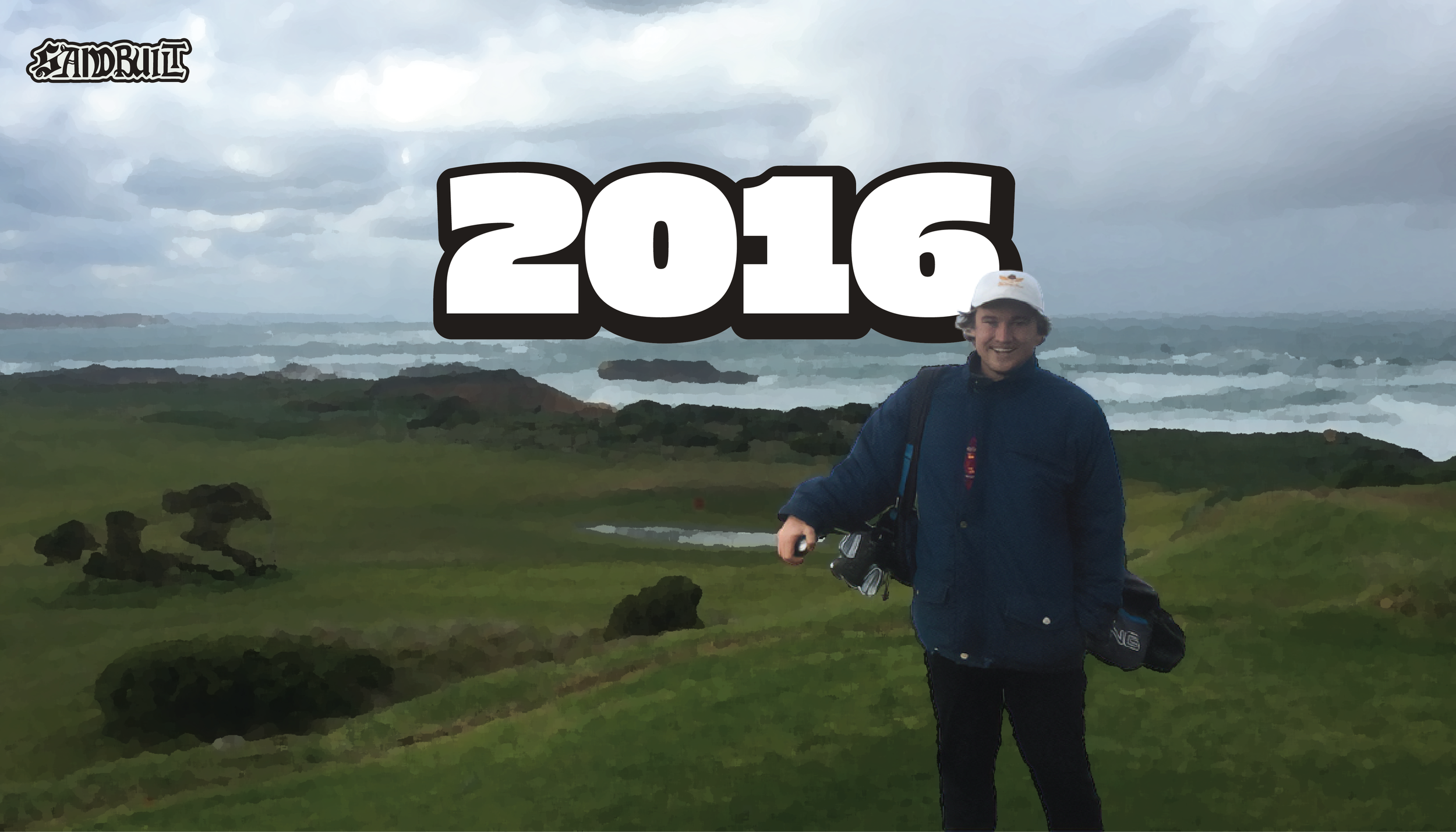
In 2016 I had been out of school for a few years and was working as a caddie at the exclusive and infamous Capital Golf Club. I had been looping there on and off for about six years, drifting without long-term commitments or a defined plan. I was looping ‘Australia’s Shadow Creek’, chauffeuring wealthy locals and international high rollers, trying to stay useful and invisible at the same time.
I roped in friends, family, and eventually my girlfriend to work there too. No arm twisting required. My girlfriend at the time, Lillie, was studying an environmental degree and juggling four jobs. We lived with two other girls, also studying, in a knock-over weatherboard house in Oakleigh South that is somehow still standing. Our neighbours were the local primary school, Metropolitan, and Huntingdale Golf Clubs. Hopefully the statute of limitations has passed, but we had what might have been the toughest par three on the Sandbelt playing from our driveway. Only one par was ever recorded. It was disputed.
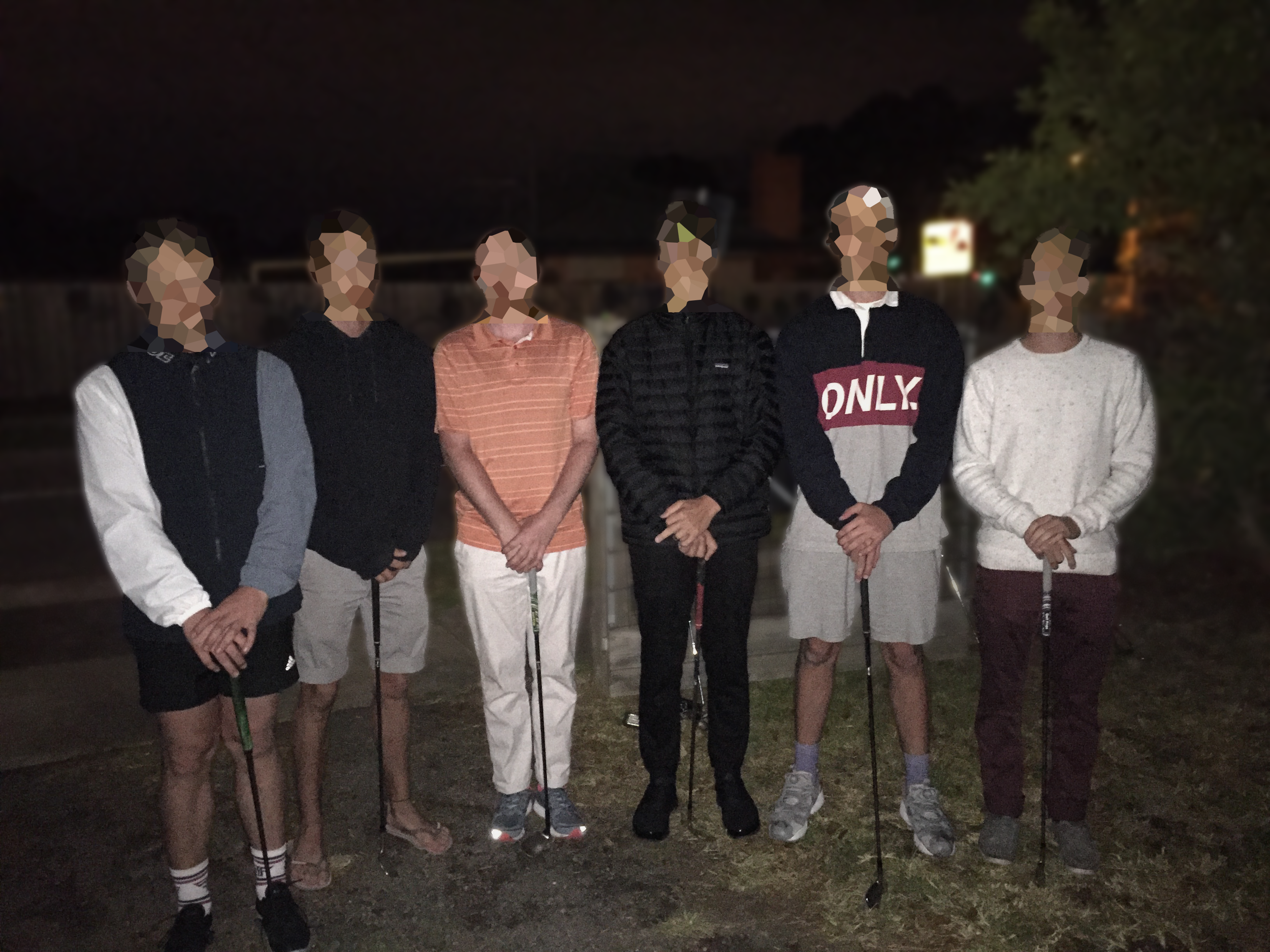
The founding members of the (redacted) Street Golf Club. Home to the hardest Par 3 on the Sandbelt.
I was making good money for someone in their early twenties and had the kind of freedom that makes you reckless in the best way. Enough independence to chase curiosity wherever it wandered. At night, I fed that creative energy into music, working out of a spare room that barely qualified as a studio. In 2016 alone I made somewhere between five to six hundred music files. That included a full album produced exclusively for Lillie’s twenty-first birthday, featuring her friends absolutely destroying the vocals of her favourite songs with enthusiasm and very little accuracy.
Most days were indistinguishable from one another. Work hard, play hard, repeat. I had no degree, no real investments, unless you count a small and poorly timed crypto portfolio. What I did have was time, and a growing sense that the world was bigger than the loops I was walking. I would recommend that phase to anyone. Just not forever.
By 2016, Lillie could see it too. That my time drifting in the sun was nearing its end. We talked about long-term investments, mostly in yourself. Saving money. Learning your craft. Taking the thing you love seriously enough to risk it failing. Maybe, if you were lucky, turning it into a life.
I loved golf. But more than that, I had developed a rough, unpolished obsession with golf course architecture. It felt like a career from another era, something that disappeared along with milk deliveries and corner butchers. Except it had not. There were still a small number of people doing this work, shaping land with intent and restraint, and I was quietly convinced I could belong among them. It promised creativity, travel, and rewards that were directly tied to effort. The problem was obvious. How do you even begin?
The answer, it turns out, was not through a grand plan.
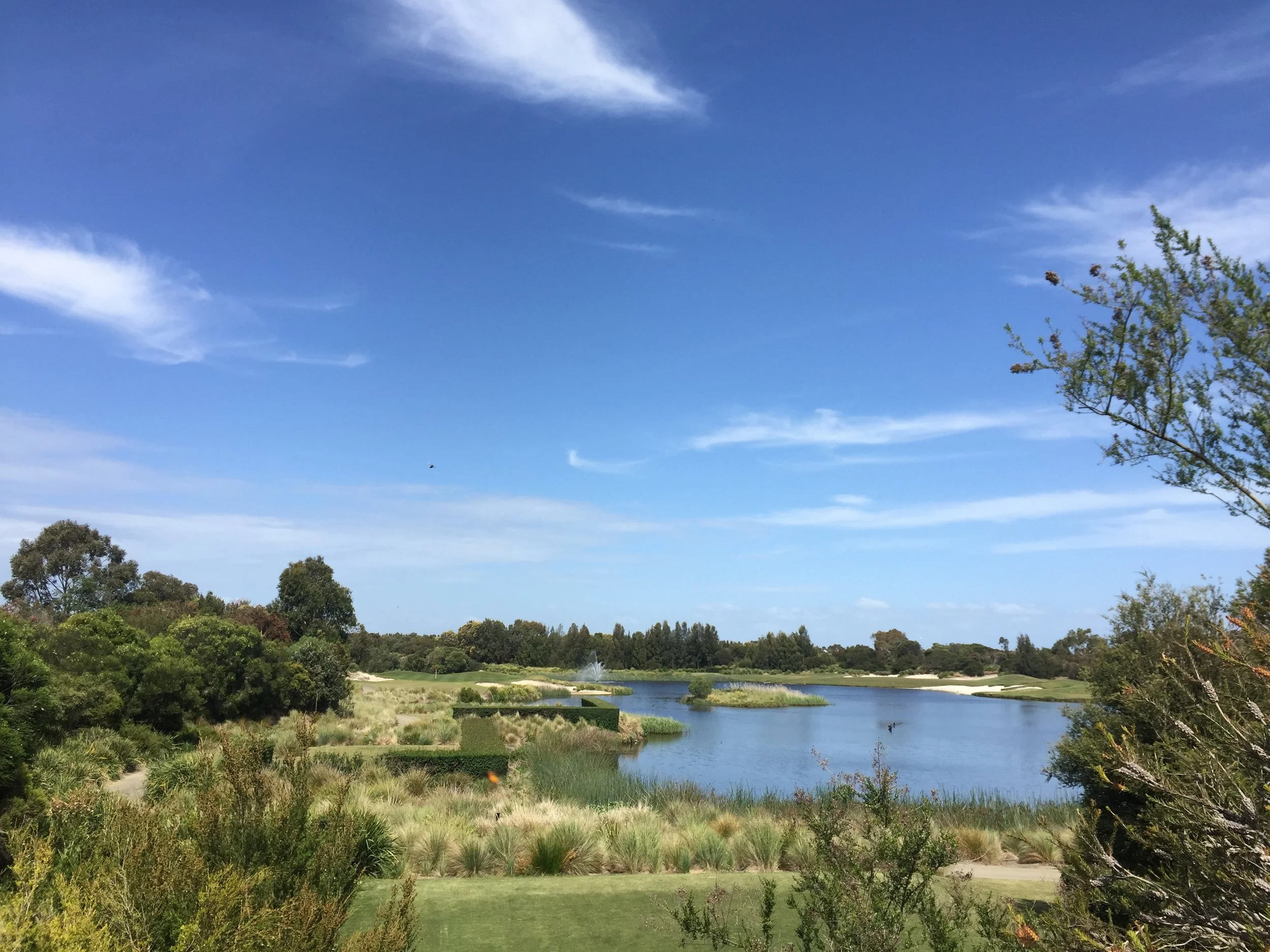
From the back tee on the 8th hole Par 3 at Capital Golf Club
At Capital, it was common for me to be on standby whenever the course owner, Lloyd Williams, decided to appear for a casual nine or eighteen. In 2016 there was a stretch where he frequently played with David Evans. Their rounds were filled with conversations about golf, but more specifically, about construction, maintenance, and the invisible work that makes great courses endure.
David owned a property past the Black Spur, winding its way toward Lake Eildon. His ambition was to build a course that belonged entirely to the Victorian landscape. That place would become Cathedral Lodge. Over weeks and months, David would provide updates to Lloyd as they walked Capital’s fairways.
They did not need a caddie. They certainly did not need me. But Lloyd knew about my primitive fascination with golf architecture and allowed me to hang around. I stayed quiet. I listened. I learned. Walking alongside those two men became one of the most influential classrooms of my life, whether any of us recognised it at the time or not.
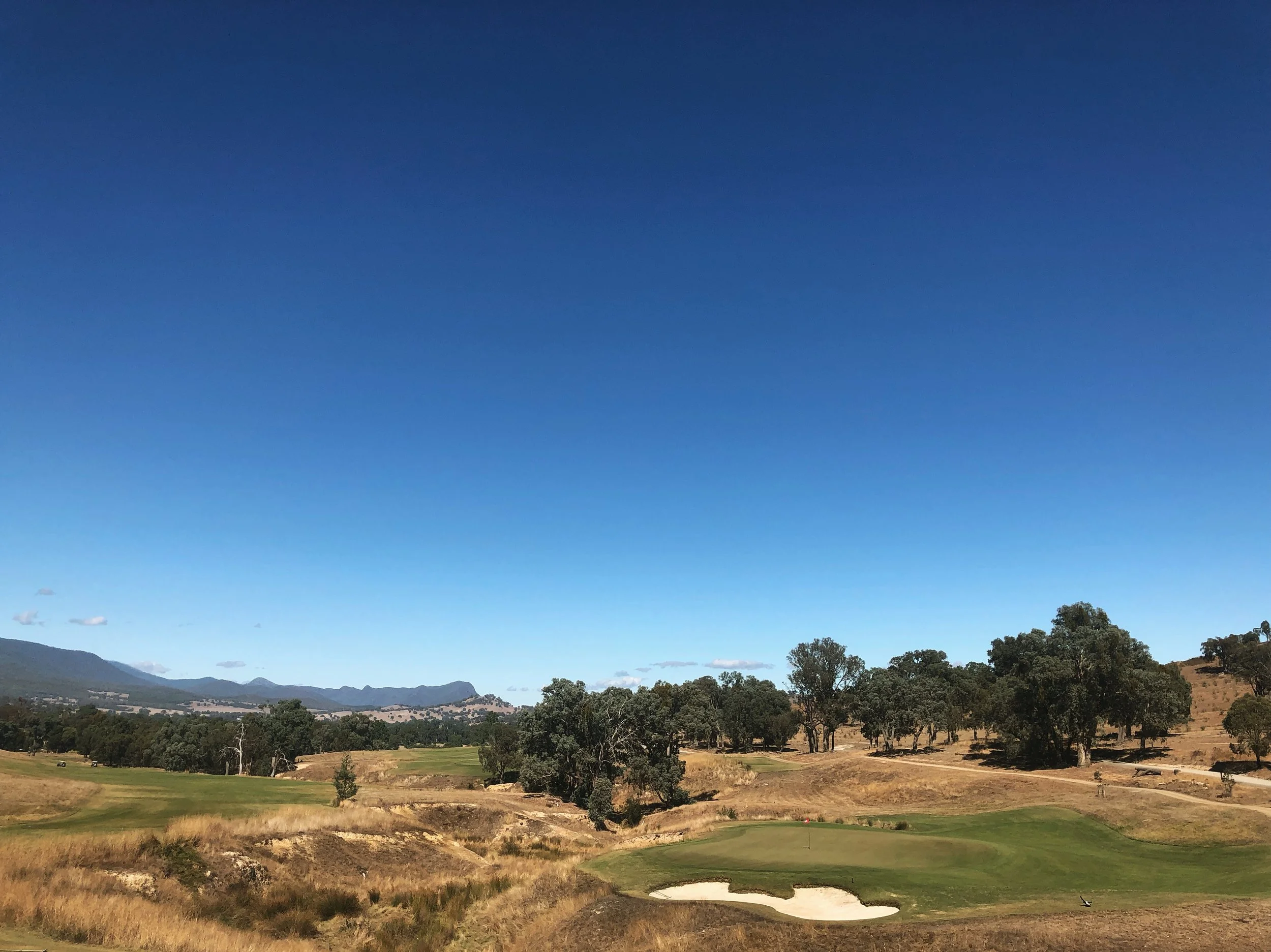
Looking back at the 17th Green at the Cathedral Lodge, roughly 10 years ago.
Once Cathedral Lodge was built, I began caddying there on the odd occasion. For David, for members, for guests. On one of those days, Cathedral hosted a match against the newly opened Tara Iti. Walking those fairways was Tara Iti’s newly appointed superintendent, Brian Palmer.
We spoke about golf architecture with the enthusiasm of people who probably should have been paying attention to something else. Brian made the mistake of giving me his contact details. For nearly the next decade, I would make full use of them. Questions, ideas, observations, all fired his way. He became one of my most important and unofficial mentors, whether he agreed to the title or not.
That meeting with Brian would not have happened without the chance to caddy for David. That opportunity would not have existed without Lloyd Williams. And none of it would have happened if I had not been caddying at Capital in 2016, aimless but curious.
In 2026, it is easier to understand how fragile and random those moments were. How easily they could have been missed. One different roster. One skipped shift. One moment of choosing convenience over curiosity.
So when I think about 2036, I try to remember that lesson. That the most important doors rarely announce themselves. They arrive disguised as small talk, shared walks, borrowed time, and chance encounters that feel insignificant until they are not.
I have not yet achieved anything of note in the field of golf course architecture. But I am ready. I am paying attention. And I know now that the next decade will be shaped less by grand plans and more by showing up, staying curious, and recognising the quiet moments that might one day change everything.
Because that is what 2016 taught me.
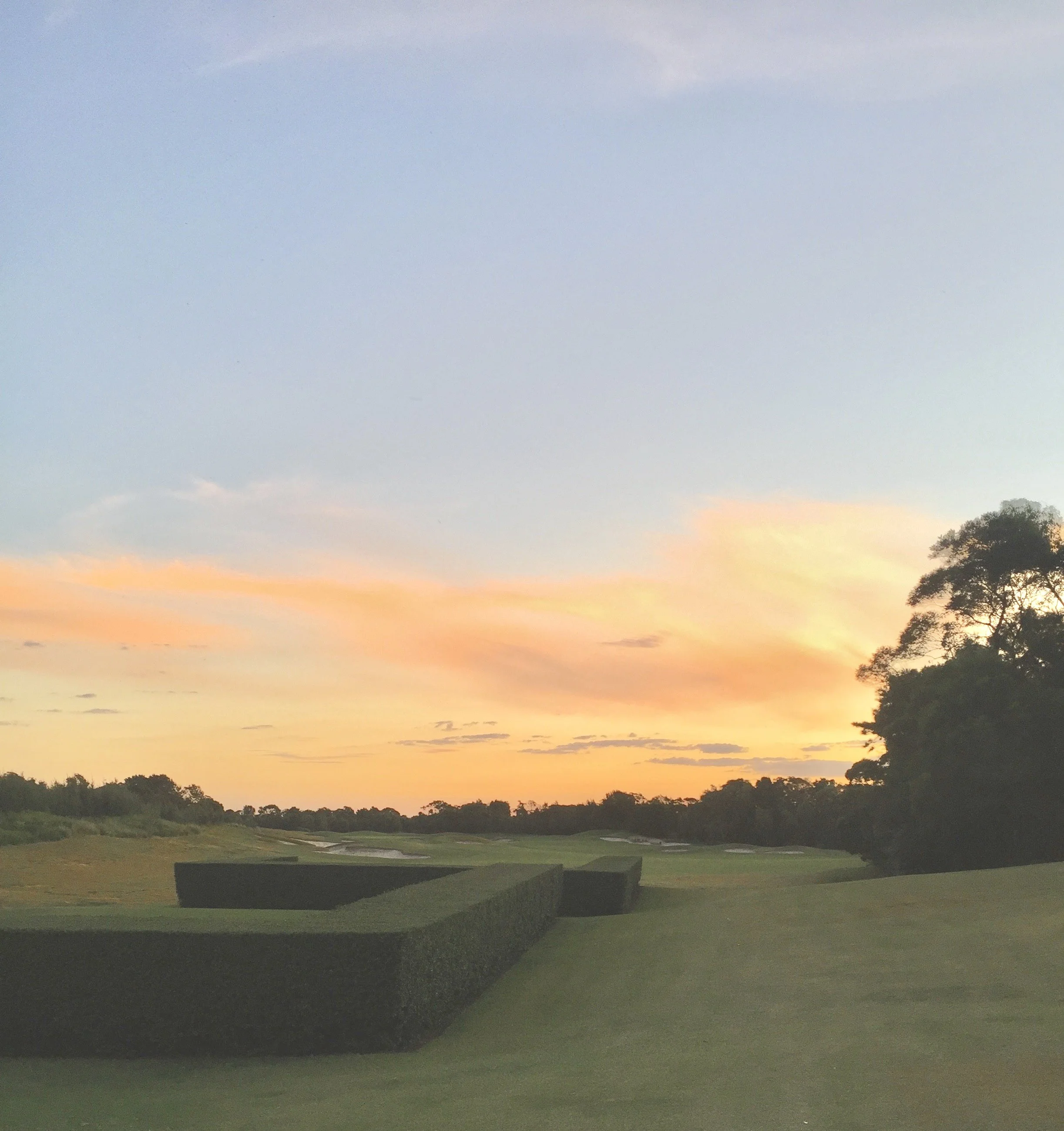
Sun setting on the 18th hole at the Capital Golf Club.