St.George’s Hill has found its flame
I have a confession to make.
Like any well-adjusted person living in 2026, I decompress after work by scrolling mindlessly through social media, scraping the gutters of “content” for one last thimble of serotonin.
Most evenings, it is grim work.
Another new golf course slides into view, looking suspiciously like the last new golf course. The same bleached palette. The same expensive rough edges. The same suggestion that somebody has taken what worked elsewhere and asked for another one of those. Swipe up. Repeat. If you have seen one, you begin to feel as though you may have seen them all.
Just as I was preparing to abandon hope, I landed a content whale.
Three collaborative posts appeared in quick succession from Angela Moser, Brian Schneider and Clyde Johnson. The grass had been stripped away from what appeared to be the 8th hole at St George’s Hill, exposing the bare carcass of one of Harry Colt’s great creations.
My brain began to flicker back into service.
The 8th? That is a bold place to begin.
I zoomed in and began examining every pixel for evidence, like a deeply under qualified detective who had nevertheless been given full jurisdiction over Surrey. The bunkers immediately caught my attention. After years of softening and neglect, they appeared to have found their teeth again. The sheer menacing scale of the central bunker back to its intended size.
Then I noticed the people standing on the the well of a green. They offered a useful sense of scale.
And then I saw the flag…
It was planted almost outside the composition of the photograph, far enough away from the recognised putting surface that it seemed improbable. I zoomed in again. Then again, as though the third enlargement might reveal a written declaration of intent.
Surely not.
Could that really be the restored edge of the green?
If it was, they were looking at something in the region of 16,000 square feet. Not a cautious tidy-up. Not the usual restoration language attached to a handful of widened mowing lines and some fashionable bunker edges. This looked like an attempt to recover the scale, strategy and audacity of Colt’s original vision.
All of this, I should stress, was deduced from a flag in the dirt.
I realise how that sounds.
But that flag was not exciting simply because the 8th green might be returning to its proper size. It suggested something larger. It established the possible tone of the restoration and, with it, the potential transformation of the entire golf course.
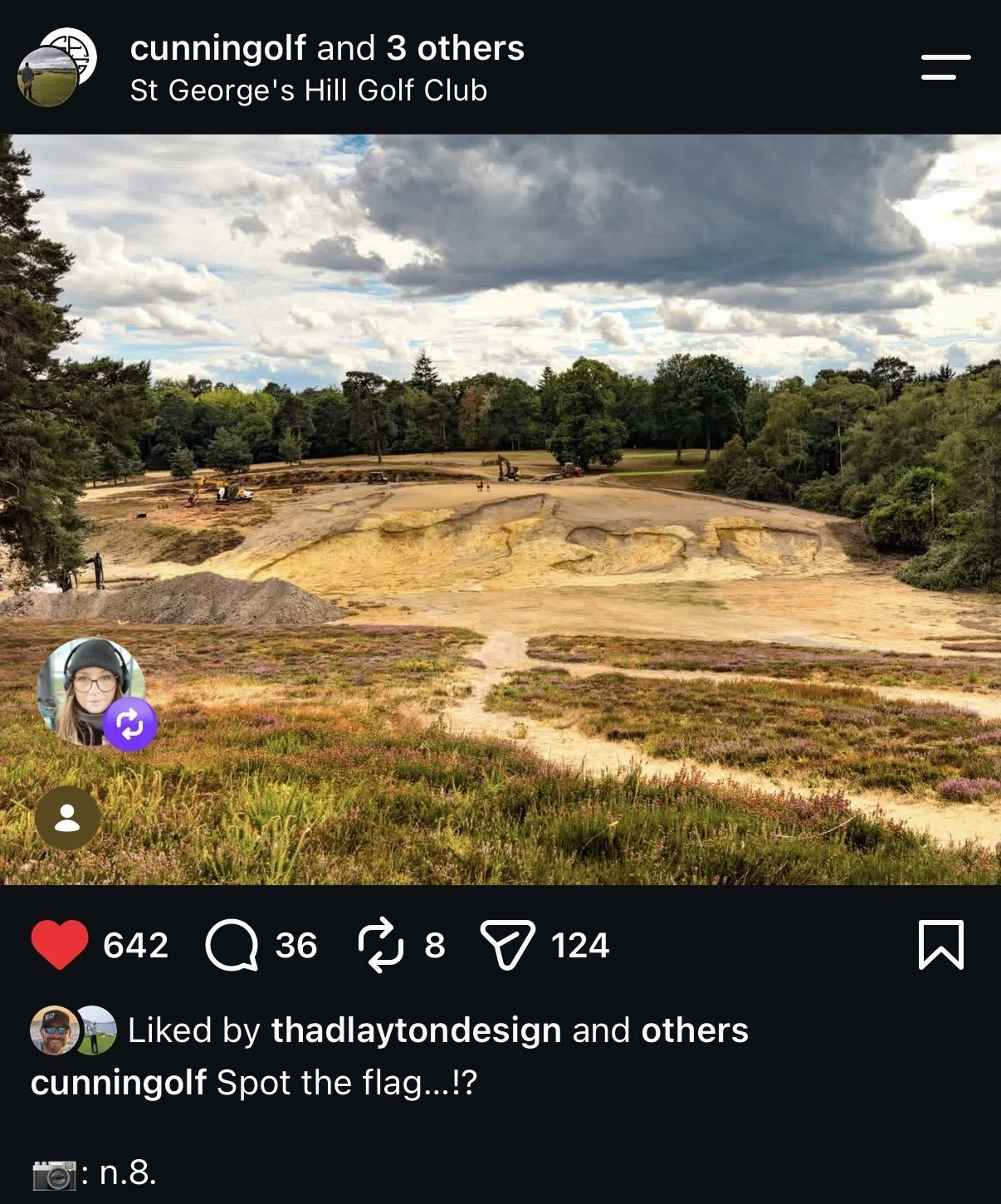
The instagram post…
St George’s Hill does not need to be reinvented. It needs to be remembered.
The ingredients are already there. The heaving terrain, the heather, the pines, the scale and the prestige of Colt’s name. It is one of those rare places where the golf course seems to possess its own internal weather. Yet, like many great courses, time has gradually blurred some of its sharpest ideas. Greens contract. Bunkers lose their edges. Width disappears. What was once bold becomes polite and softly spoken.
Restoration, at its best, is not an exercise in making an old golf course look new. It is the removal of accumulated manners.
That is why the appointment of Moser, Schneider and Johnson (The ABC’s) feels so important. Brian has built a reputation as one of golf architecture’s more committed historical policemen. Angela and Clyde bring their own quiet detective work in the background, practical understanding and instinct for finding what a golf course has been trying to say beneath decades of alteration. They are the best people for the job.
Between them, they appear unusually well equipped to distinguish between historical intent and historical clutter.
Of course, no restoration team operates with complete freedom. Committees deliberate. Members worry. Budgets tighten. Trees acquire unlikely emotional constituencies. Every bold idea must survive a procession of entirely reasonable people asking whether it really needs to be quite so bold.
That may be the only thing standing between St George’s Hill and its full potential.
Because if Moser, Schneider and Johnson are given a clear runway, and if the club has the courage to follow the evidence wherever it leads, there is no reason St George’s Hill cannot become the best golf course in England.
That is not to say England lacks contenders. It is to recognise how much is already present at St George’s Hill, and how little needs to be invented. The opportunity is not to manufacture greatness, but to uncover it.
Perhaps I have read too much into one photograph. Perhaps the flag was planted there temporarily. Perhaps it marked a drainage outlet, a lunch order or the precise location where three golf architects had agreed to bury a rock.
But I do not think so.
I think it was a small flag signalling an enormous amount of ambition.
The next destination golf course can wait. For now, the course I am craving to play is an old one in Surrey, being slowly stripped back to reveal just how good it may have been all along.