Golf is Still for Old People
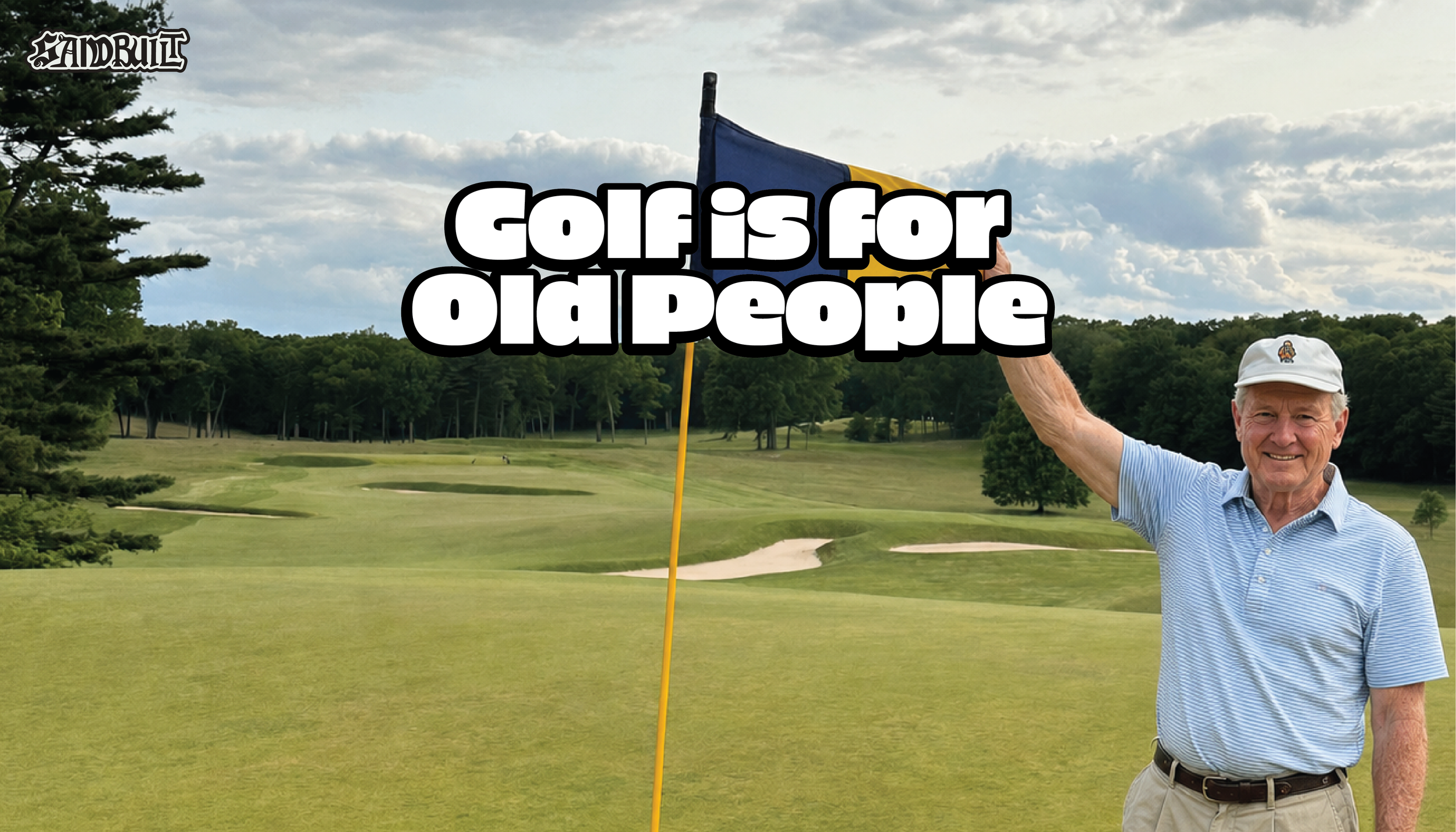
Let me take you back to my teenage years.
It's a Saturday night somewhere on the outskirts of Melbourne. Out past where the trains run.
It's an old saying that always made sense to me. The suburbs had stretched further than the infrastructure had. It was a little rough around the edges. More blue-collar than blue blood. More Commodores than country clubs. It was a long way from the manicured image of Melbourne's Sandbelt. It felt much closer to the old Croydon Golf Club where I'd be teeing off the following morning.
Warm cans of beer. Music echoing through the garage that had temporarily transformed itself into a dance floor. These were social evenings where reputations were made and lost. Stay long enough to prove you weren't boring. Don't stay so long that you made a fool of yourself. If you were lucky, you might even convince a girl to tolerate your company for longer than twenty minutes.
All the while, there was one thing sitting quietly in the back of my mind.
An 8:12 tee time at Croydon Golf Club.
The great social challenge wasn't surviving the party.
It was leaving it.
Too early and you were labelled a loser. Too late and Sunday's golf was ruined before you'd even hit the first tee shot. So, somewhere around midnight, I'd begin the slow, awkward extraction. A few vague goodbyes. A disappearing act towards the front door. Usually interrupted by someone asking the inevitable question.
"Where are you going?"
Without fail I'd mumble something that sounded embarrassingly uncool.
"I've got golf tomorrow morning."
The response was almost always identical.
"Golf?"
"...isn't golf for old people?"
At the time, I hated hearing it.
Now I think they might have been right.
Not because golf isn't attracting younger people. Quite the opposite. Many of the same people who laughed at me back then have now discovered golf for themselves. Every second bloke I grew up with seems to be documenting their Road to Scratch, uploading swing videos that absolutely nobody asked for and suddenly developing very strong opinions on low-spin golf balls and bounce angles. Golf appears to be booming amongst people in their thirties.
I just don't think that's as revolutionary as everyone makes it out to be.
Football starts hurting. Cricket consumes an entire weekend. The psychopaths discover marathons and triathlons.
The rest of us discover golf.
Golf hasn't become younger. We've simply become older.
And once that thought lodged itself in my head, it became very difficult to ignore.
For the last few years we've spoken about golf as though it's experiencing some great youth movement. Every article seems to celebrate another influx of Millennials, another waiting list, another impossible Saturday morning tee sheet. The assumption is that golf has suddenly become fashionable.
I'm not convinced.
I think we've mistaken growth for accumulation.
Golf isn't simply attracting new players. It's retaining old ones for longer than ever before.
People don't get old like they used to.
The seventy-year-old golfer of today often resembles the fifty-five-year-old golfer of thirty years ago. They're healthier. They're stronger. They retire with more time, more money and better equipment than previous generations ever enjoyed. Golf should celebrate every bit of that. It is one of the great success stories of modern sport.
But success has consequences.
Whenever conversation turns to crowded golf courses or impossible tee times, younger golfers become the convenient target. It's the Instagram generation. The hoodie brigade. The YouTube golfers filming every shot before telling us they "left it out there today."
I don't think they're the reason.
I think we've quietly overlooked the generation that never left.
The old golfers I remember from Sunday mornings haven't disappeared. They're still somewhere across Melbourne's eastern suburbs. Kicking the dew off fairways before most people are awake. Telling the same stories that somehow improve with every passing year. Arguing over gimmies. Having the same friendly disputes over whose shout it is in the clubhouse. Perhaps a little weary from the night before, but never too weary for golf.
Somewhere along the way I became the age they always seemed to be.
They just kept playing.
You can almost read that story through the architecture of modern golf.
Look around any golf club that has invested heavily over the last twenty years. Additional tee complexes. Longer championship tees. Forward tees. Kilometres of cart paths. Bridges designed for fleets of golf carts. Larger cart sheds. Charging stations. Gentler walking grades. So much of modern golf construction has been devoted to extending playing careers.
None of that is a criticism.
Accessibility matters.
Keeping people playing matters.
I'd argue it's one of golf's greatest achievements.
But golf courses are historical documents. Every bridge, every path and every tee tells you something about the generation that built them. Ours tells the story of a game determined to help people play for as long as possible.
There's another irony hiding in plain sight.
Technology has helped younger golfers hit the ball dramatically further than previous generations, forcing courses to stretch backwards. Meanwhile, many older golfers refuse to move forward because a different coloured tee somehow feels like surrender. So we continue building more infrastructure rather than embracing the infrastructure we've already built.
Golf has become exceptionally good at extending playing careers.
I'm just not sure we've spent the same amount of energy asking what sort of game we're extending.
Because if we continue building a game almost exclusively around today's golfers, what exactly are we handing to tomorrow's?
That, for me, is the more interesting question.
Before every retired member reaches for the keyboard, let me say this.
Some of the greatest golfers I've ever known have also been the oldest.
They were the people who first taught me that golf wasn't simply about making birdies. They taught me why Alister MacKenzie mattered before I knew who he was. They taught me that the walk between shots was often the best part of the round. They taught me that golf wasn't simply recreation. It was history. It was architecture. It was community.
Most importantly, they taught me stewardship without ever calling it stewardship.
I think about legacy a lot. My profession almost demands it. Every golf course we restore, every bunker we reshape and every green we expand is an acknowledgement that someone else will inherit those decisions long after we're gone. You begin to understand that time is the most important design material you work with.
Perhaps that's why I find myself repairing two pitch marks instead of one.
Why I'll fill a divot that isn't mine.
Why I'll happily spend five minutes talking to a nervous junior before their first competition.
Not because those things change the world.
Because they quietly shape the one that comes after you.
Golf has spent decades making itself a wonderful game for older people.
Now it needs older golfers to do what they've always done best.
Show the rest of us how to look after it.
One day the Golden Generation will hand the game to mine.
One day mine will hand it to the next.
I still think about those Saturday nights from time to time. Leaving early never felt particularly cool. At fifteen, I thought I was sacrificing something.
Looking back, I wasn't.
I was inheriting something.
One day I'll probably be one of those old blokes somewhere east of Melbourne, kicking the dew off a fairway before the sun has properly risen. I'll tell stories that become slightly better every year. I'll probably complain about bunker sand. I'll almost certainly think golf balls went further in my day.
When that happens, I hope the teenager standing on the first tee looks at me and quietly says,
"Golf is still for old people."
I hope they're right.